
The world of complex financial systems revolves around liquidity,'I'd simply sum these up into, two categories
- Liquidity Source
- Liquidity Sink
In the context of trading, liquidity refers to the ability to buy or sell an asset (such as a cryptocurrency) with the goal being quick and with minimal price impact.
A “liquidity pair” is a trading pair in which there are two different tokens, allowing many buyers and sellers to trade these tokens, thus affecting the price of the pair. Only buys and sells affect the price of a trading pair, adding liquidity does not as the added liquidity is 1:1 which only helps to stabilise the price fluctuations in the pool.
A “liquidity source” provides a large amount of liquidity for a particular asset.
A “liquidity sink” is the opposite it absorbs a large amount of liquidity for a particular asset. A store of value.
What happens if we double these categories
There are now two liquidity sources and two liquidity sinks.
When one of these a source or a sink interacts with buyers or sellers the other pair for a moment or period is at a different price which can only be higher or lower compared to the other pair.
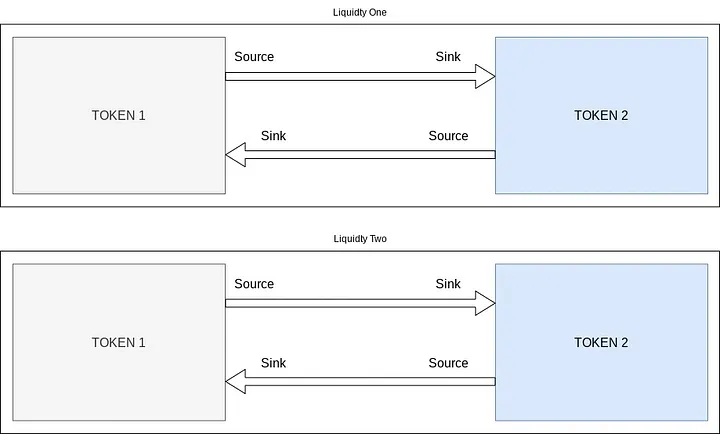
We now have an arbitrage opportunity where we can introduce a new buyer or seller who 'asn't been involved in the original trade but has created balance among the liquidity sources and liquidity sinks, while at the same time creating a profit via trading fees for the liquidity providers.
Arbitrage trading can be done manually by traders who keep track of price differences across different markets and execute trades accordingly. However, with the advent of technology and the increasing number of exchanges and markets, it has become more common for traders to use arbitrage trading bots to automate the process.
An arbitrage trading bot is a software program that monitors price differences across different markets and executes trades automatically when it detects an opportunity for profit. These bots can be programmed to scan multiple markets and exchanges at once and can execute trades much faster than a human trader could. They can also be programmed to take into account factors such as trading fees and order book depth to maximize potential profits.
If we increase the number of tokens that are inter-tradeable with each other this creates more opportunities for buyers, sellers, and arbitrage trading.
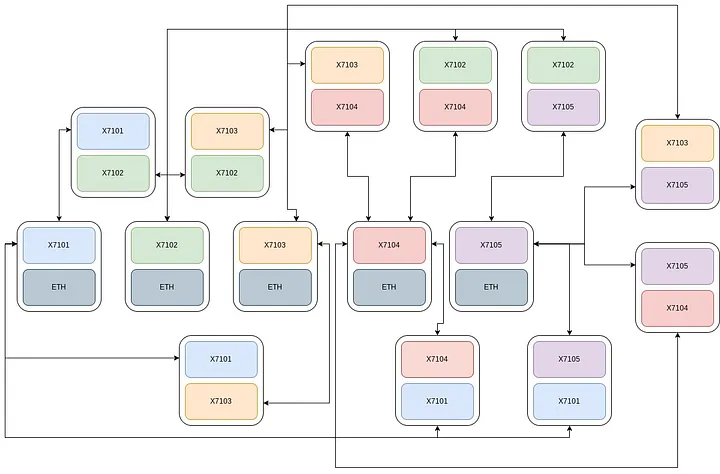
What if the trading profits from the liquidity provider were re-invested into the liquidity sink?
And at the same time, it purchased and burned one of the tokens reducing the supply.
As more trading activity in the pools increases, the demand for the tokens also increases, which can drive up the price. The reinvestment of trading fees and token burns also help to support the price by decreasing the supply and increasing the demand.